

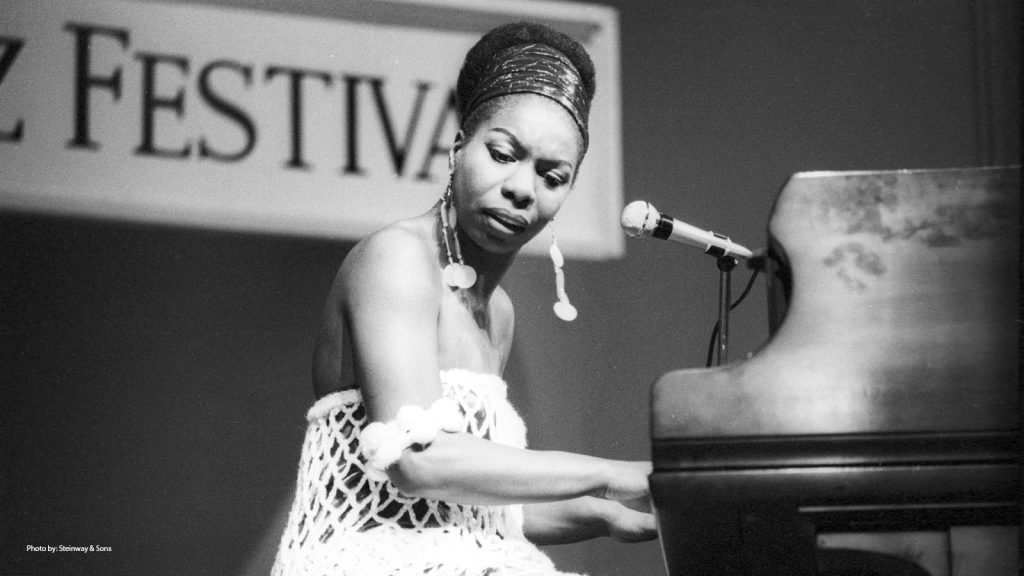
Before the world knew her as Nina Simone, she was Eunice Kathleen Waymon, a gifted child growing up in Tryon, North Carolina.
Music arrived early in her life. By the age of three, she was already playing the piano by ear. By the time she was ten, she was performing classical recitals in her community. Those who heard her recognized something rare in the young pianist, and neighbors organized what became known as the Eunice Waymon Fund, raising money so she could pursue formal musical training.
Her dream was clear from the beginning.
She did not want to become a nightclub singer or a jazz performer.
She intended to become America’s first Black female classical concert pianist.
A Dream Interrupted
Waymon pursued her studies with intense discipline. She trained in classical piano and later attended the Juilliard School for a summer program, preparing for the audition she believed would define her future.
That audition was at the prestigious Curtis Institute of Music.
She played brilliantly.
Yet she was rejected.
For Simone, the meaning of the rejection was unmistakable. She believed the decision was not based on her talent, but on the color of her skin. The moment would remain a defining wound throughout her life.
The path she had carefully prepared for suddenly disappeared.
But the story did not end there.
The Birth of Nina Simone
After the rejection, Waymon needed work. She found it playing piano at the Midtown Bar and Grill in Atlantic City.
There was one problem.
Her mother was a devout minister who would never approve of her daughter playing secular music in a nightclub.
So Eunice Waymon created a new identity.
She chose the name Nina, a nickname meaning “little girl,” and Simone, inspired by the French actress Simone Signoret.
With that name, Nina Simone was born.
At first, she was hired simply to play piano. But when the club owner demanded that she sing in order to keep the job, something unexpected happened. Simone began to combine her classical training with gospel phrasing, blues expression, and popular songs.
The industry would later label her music jazz.
But Simone rejected that description.
Black Classical Music
Simone often insisted that what she played was not jazz.
To her, the term was limiting, a category critics often used to contain Black musical brilliance within a narrow framework.
She preferred another term.
Black Classical Music.
Her piano technique was deeply rooted in the classical traditions she had studied since childhood. Bach-like structures, complex harmonies, and disciplined phrasing remained central to her playing.
Even when performing songs that audiences considered jazz, Simone approached them with the precision and intellectual structure of a classical musician.
She had not abandoned classical music.
She had expanded it.
Recognition at the End
For decades, Simone carried the memory of her rejection from the Curtis Institute. It shaped her view of the music world and the barriers placed before Black artists.
Then, near the end of her life, something remarkable happened.
On April 19, 2003, the Curtis Institute of Music awarded Nina Simone an honorary degree, formally recognizing the brilliance of the artist they had once turned away.
It was a moment of long-delayed acknowledgment.
Two days later, on April 21, 2003, Nina Simone passed away.
A Circle Closed
Simone died not simply as a singer, or even as a jazz legend. She died as the artist she had always believed herself to be, a musician of profound discipline and intellectual depth.
In the final days of her life, the institution that had once closed its doors to Eunice Waymon finally recognized her as a master.
History had corrected itself.
And the young pianist who once dreamed of becoming a classical artist had, in the end, reshaped modern music in ways far beyond the concert halls she once imagined.