

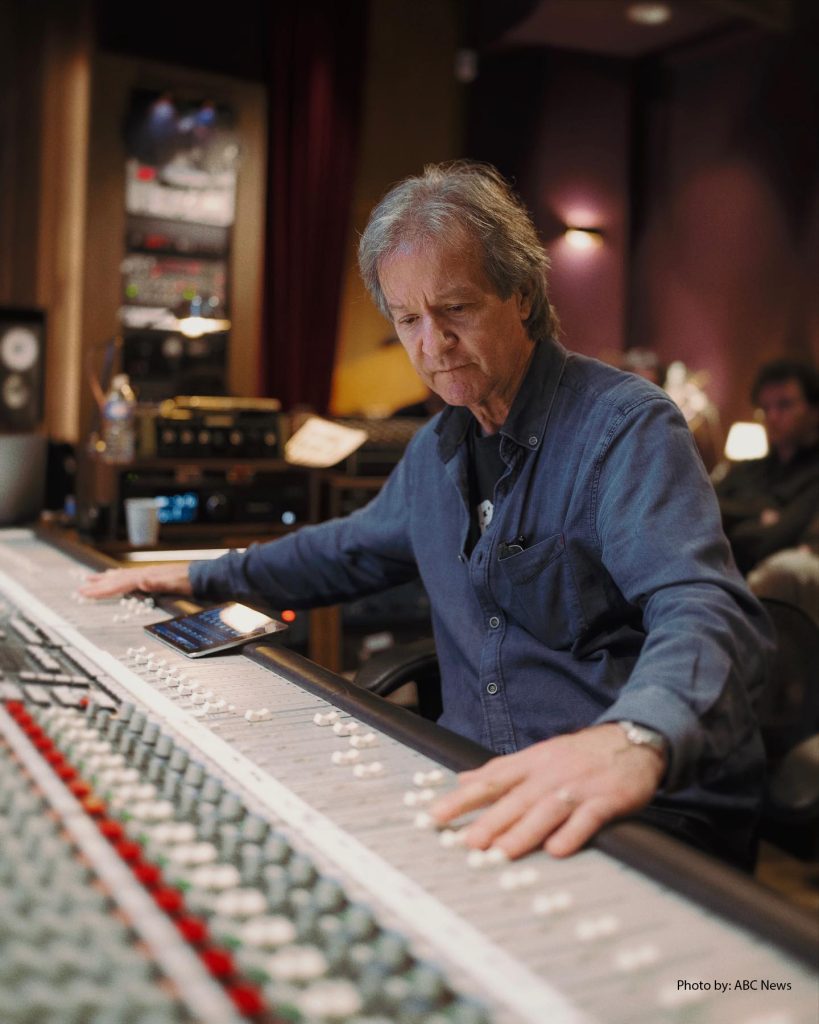
Bob Clearmountain
In the history of recorded music, certain engineers redefine not only how records are made, but how listeners experience sound itself. Their work becomes a blueprint—quietly shaping the sonic language of entire generations.
Few engineers embody that influence more clearly than Bob Clearmountain.
From the late 1970s through the 1990s, Clearmountain helped define the sound of modern rock and pop. His mixes were powerful, expansive, and unmistakably clear, creating records that felt larger than the rooms in which they were recorded.
In many ways, Clearmountain helped transform mixing from a technical step in the recording process into a creative discipline of its own.
The Rise of the Modern Mix Engineer
Before the 1970s, the role of the mixing engineer was often secondary to the recording process itself. Engineers focused primarily on capturing performances accurately, and mixes were generally straightforward balances of instruments.
But as multitrack recording technology expanded, so did the possibilities of sound.
Clearmountain emerged during this moment of transformation. Working in major recording studios in New York and later Los Angeles, he began to approach mixing as an act of sonic design.
A mix was no longer just a balance.
It was an environment.
Through careful use of equalization, compression, delay, and reverb, Clearmountain created mixes that felt immersive and dimensional. Instruments occupied distinct spaces within the stereo field, giving listeners the sense of stepping inside the music rather than merely hearing it.
The Power of the Drum Sound
One of Clearmountain’s most recognizable contributions to modern music lies in his treatment of drums.
Rather than presenting drums as background rhythm elements, Clearmountain’s mixes placed them at the center of the sonic experience. His approach combined carefully recorded drum rooms with gated reverbs and precise processing to create a sound that was both explosive and controlled.
The result was a drum presence that defined countless records of the 1980s.
This sound can be heard across major releases from artists such as Bruce Springsteen, The Rolling Stones, and Bryan Adams.
In these mixes, drums were not simply rhythmic foundations—they were architectural pillars of the entire recording.
Space, Depth, and Stereo Vision
Clearmountain also helped pioneer the modern concept of stereo depth in mixing.
Instead of placing instruments simply left or right, his mixes used layers of ambience and delay to create distance and perspective. Some elements felt close and immediate, while others appeared farther away, giving the recording a sense of three-dimensional space.
This technique allowed records to feel expansive without becoming cluttered.
Listeners could hear every element clearly, even in dense arrangements.
The mix itself became a carefully constructed landscape.
Mix This!: A Studio Built for Mixing
As his career progressed, Clearmountain built his own mixing environment known as Mix This!.
Unlike traditional recording studios designed primarily for tracking musicians, Mix This! was built around the specific acoustical and technical needs of mixing.
The room allowed Clearmountain to refine his craft with exceptional precision. Its layout, monitoring system, and equipment were all designed to support one goal: creating mixes that translated beautifully across any listening environment.
Within this space, countless iconic records were shaped and finalized.
Technology and the Transition to Digital
Clearmountain’s influence also extended into the development of professional audio technology.
He collaborated with companies such as Apogee Electronics, helping refine digital converters that improved the quality of digital recording systems during the industry’s transition away from analog tape.
His involvement ensured that digital technology could meet the sonic standards demanded by professional studios.
This work helped bridge two eras of recording history.
Legacy
The influence of Bob Clearmountain can be heard across decades of modern music. His approach to mixing, balancing clarity, power, and spatial depth, became a model for engineers around the world.
More importantly, Clearmountain helped elevate mixing into a creative art form.
His work demonstrated that a mix is not merely the final technical stage of production. It is the moment where sound becomes architecture, where instruments, voices, and atmosphere are shaped into a cohesive sonic experience.
Today, the techniques he pioneered continue to influence how records are made.
In the quiet discipline of the control room, Clearmountain helped design the sound of modern music.
Bob Clearmountain
The man who essentially “invented” the role of the specialist mix engineer